A 14-year-old boy who was self-radicalised online was prepared to carry out a mass-casualty stabbing attack at his secondary school after creating a 21-page manifesto detailing the attack. He was arrested by the Internal Security Department (ISD) in May 2026, a month before his planned attack, and issued with a detention order. The Secondary 2 student was among three teenagers who were detained under the Internal Security Act (ISA).
Another of them was a 15-year-old Secondary 4 student who was self-radicalised online by Islamic State in Iraq and Syria (ISIS) ideologies, and planned to conduct an attack in Singapore to further the group’s cause and establish an Islamic caliphate in Southeast Asia through violent means. The two secondary school students were not named as they are under 18. The other case involved 19-year-old tertiary institution student Tan Jun Jie, who also supported ISIS and planned to carry out knife attacks against Singapore Armed Forces (SAF) troops at Sembawang Air Base and LGBTQ students in his school.
Tan also attempted to conduct cyberattacks against the websites of Muslim organisations that he deemed deviant. Though their cases are not related, all three were self-radicalised online by violent extremist ideologies, and had made preparations to conduct local attacks. The schools that were targets in the attack plots were not identified by ISD.
The 14-year-old is the youngest person to be detained under the ISA.
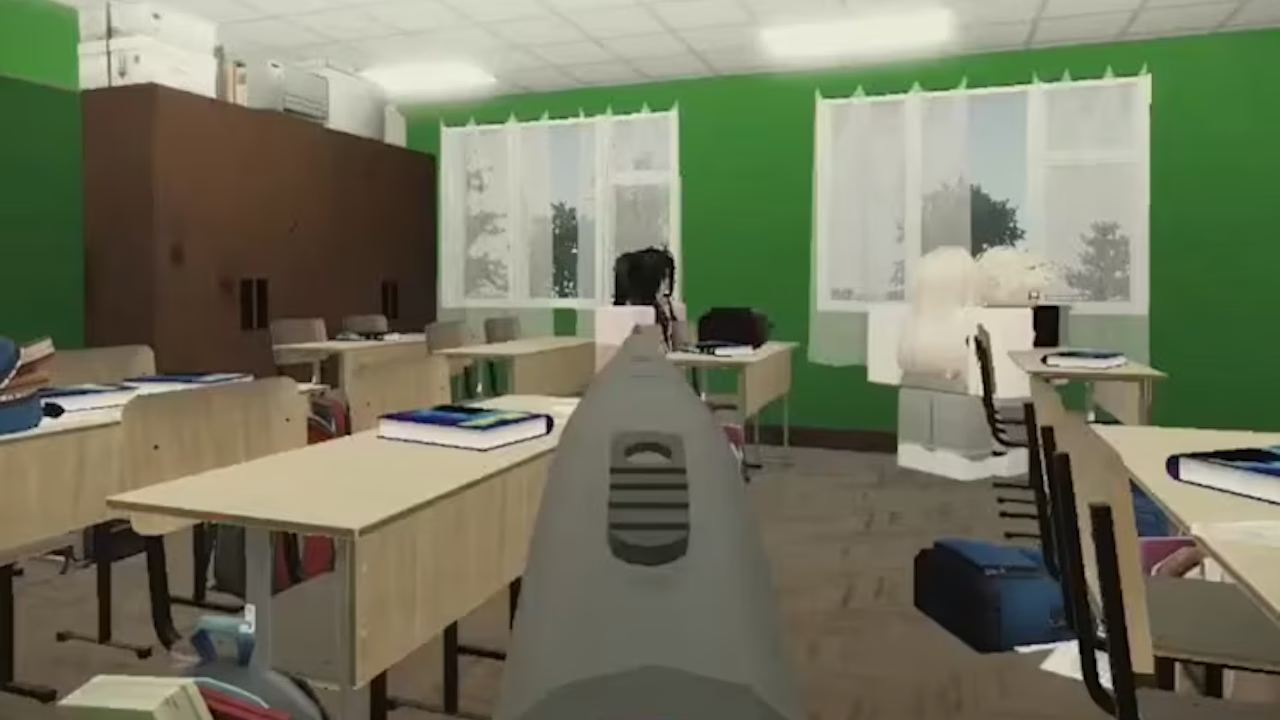
It is also the first detention involving Composite Violent Extremism (CoVE), previously known as “salad bar” extremism. This refers to a form of violent extremism where individuals subscribe to multiple, and sometimes conflicting, extremist ideologies. The 14-year-old boy’s radicalisation journey began with first-person shooter (FPS) games on online gaming platform Roblox, which recreated real-life school shootings, such as the 1999 Columbine High School incident.
Out of curiosity, the teen searched for more information online, and learnt that several mass shooters had been victims of bullying, and their acts of violence were a form of retaliation against those who had wronged them. He identified with these mass shooters, as he claimed to have also been a victim of bullying. His social media algorithm also fed him violent gore and mass shooting content, while he joined online channels in the True Crime Community.
While playing the games and watching the violent footage online, the teen imagined his bullies as the in-game characters and the victims in the videos, and himself as the perpetrator of the violent acts. In 2024, he came across on social media ISIS supporter Omar Mateen’s 2016 mass shooting on a Florida gay nightclub. He idolised Mateen as he related with the latter’s experience of being bullied, and admired Mateen’s high kill count during the attack.
The teen believed it was justifiable to kill gay people, as he considered them to be haram in Islam.
After consuming more ISIS content, the teen began supporting the group’s killing of kuffar, whom he defined as non-Muslims, and was willing to attack them if instructed by ISIS. He also considered travelling to Syria to join the group, but lacked the resources. He shared ISIS-related videos with his friends, including several schoolmates, to flaunt his support for ISIS and promote the group.
None of the teen’s schoolmates was radicalised by his attempts. He was also exposed to far-right extremist materials, including anti-Semitic and neo-Nazi narratives, eventually developing such views over time, such as support for Adolf Hitler’s killing of Jews as he believed they were responsible for mistreating Palestinians in the ongoing Israeli-Palestinian conflict. The ISD added that he supported the notion of white supremacy and considered himself more “white”, as he perceived himself to be fair-skinned.
By late-2025, fuelled by personal grievances at being bullied by his schoolmates and put under academic stress by his teachers, the teen planned to conduct a mass-casualty attack against non-Muslim teachers and schoolmates at his school during the then-upcoming school holidays in June 2026. He timed his planned attack with the school holidays as he thought there would be fewer teachers present to stop his attack, and had identified specific days when he and his targets would be present in school for co-curricular activities. He wanted to use firearms for the attack, but changed his mind due to Singapore’s strict anti-gun laws.
The teen then considered using a homemade bomb, researching bomb-making materials and how to procure them, but lacked the funds to purchase the materials nor a suitable place to construct and test the bombs.
Instead, the teen chose a kitchen knife and penknife, after gaining confidence in his ability to carry out a stabbing attack from watching ISIS execution and stabbing tutorial videos repeatedly. Inspired by far-right terrorists, such as Christchurch shooting Brenton Tarrant and other mass shooters, he intended to livestream the attack. In January 2026, he drafted a 21-page manifesto detailing his attack plan, including his choice of weapons and a list of his targets that included non-Muslim teachers and students at his school.
The manifesto featured neo-Nazi and far-right symbols, and glorified mass shooters whom the teen idolised. He had planned to disseminate the manifesto, titled “A Call to Action to encourage others who were bullied to stand up for themselves and respond with violence”, on his social media accounts one day before his attack. ISD described the incident as a “close shave”.
The detailed planning and preparation attest to the teen’s determination to follow through with his attack plan. He admitted that he would have executed his attack, had he not been arrested by ISD. Fortunately, someone in his school had noticed his signs of radicalisation and alerted the authorities. In another case, a 15-year-old boy’s radicalisation was triggered by Hamas’ attacks against Israel in October 2023, following which he was exposed to online content depicting the suffering of Palestinians.
Around the same time, the youth had joined several online groups to learn more about Islam, where he encountered violent extremist content that encouraged support for terrorist groups.
The excessive consumption of extremist narratives related to the Israeli-Palestinian conflict led him to develop a hatred for Israelis, the Israel Defense Forces, and Zionists. The youth supported terrorist and militant groups who fought against Israel, including Hamas, Hezbollah, and the Houthis, viewing their acts of violence as a form of jihad. In 2024, he briefly considered travelling to Gaza to join Hamas on the frontlines of the conflict and researched potential travel routes, but did not proceed as he felt he lacked the resources.
The youth instead took to social media to express his views, such as creating and posting a video encouraging Muslims to undertake armed violence for the Palestinian cause. Concurrently, through the online groups he was active in, he developed an interest in historical Islamic caliphates and ISIS. He became convinced of the need to establish an Islamic caliphate to revive the ‘Golden Era’ for Islam and for Muslims to live in a society ruled by sharia.
The youth felt proud about ISIS’s success in establishing a caliphate in Syria in 2014, and believed that the group’s use of violence was the most effective way to achieve that aim. By the middle of 2025, he wanted to establish an Islamic caliphate within Southeast Asia through violent means, comprising Muslim-majority countries Indonesia, Malaysia, and Brunei. Termed the Malaya Caliphate, he believed that it would be easier to recruit like-minded individuals to this cause due to these countries’ proximity to Singapore.
To prepare for engaging in armed violence, the youth sought information online on making homemade explosives.
To recruit for his caliphate, the youth created several chat groups on social media, and indiscriminately added his online contacts including his friends and family members. In these chat groups, he shared pro-ISIS content. He also created a flag to represent his caliphate and printed it via an e-commerce retailer with his mother’s help. He had told her that the flag was “to show his support for Palestine”.
The youth pledged allegiance to ISIS publicly on social media late last 2025 and saw himself as an ISIS member thereafter. He aspired to travel to Syria or Iraq to live under ISIS’s rule to support and fight for them, although he did not have a timeline in mind. He searched online for flights to Syria from Singapore, and for overseas shooting ranges where he could familiarise himself with weapons handling.
The youth also intended to use his future National Service stint to equip himself with firearms training, physical fitness, and the mental resilience to fight for ISIS. He believed that ISIS-inspired attacks, such as the December 2025 Bondi Beach shooting, were justified as revenge for the loss of ISIS fighters in battle. He viewed secular states which labelled ISIS as a terrorist organisation, such as Singapore, as enemies of ISIS, and attacks by ISIS against such states as justified.
In this regard, the youth aspired to conduct an attack in Singapore in furtherance of ISIS’s cause, using ‘pressure cooker’ bombs that he had learnt about from an online video that he watched on the 2013 Boston Marathon bombing.
The youth searched online for the cost of a pressure cooker and ways to make such a bomb, and also looked at purchasing potassium nitrate after learning about its use in the Qassam rockets used by Hamas in the 7th October 2023 attacks. At the point of his arrest, he was in the early stages of planning. He had yet to develop a timeline, location or target for his attack, but had visualised the attack to be conducted in an urban setting, with multiple civilian casualties.
While the youth claimed not to have shared his attack aspirations with anyone, his family and friends appeared to have been aware of his extremist views, but none reported him to the authorities. The oldest of the detained trio was 19-year-old Tan Jun Jie, a Muslim convert who began practising Islam in 2022 after being introduced to the religion through social media content. In late 2022, he was exposed to the online extremist teachings of foreign preachers and subsequently to rigid and fundamentalist religious beliefs, which primed him to be susceptible to radical content that he later came across from January 2025.
By late 2025, Tan believed that armed violence was permissible against non-Muslims, Shi’ite Muslims, and other Muslims whose understanding of Islam deviated from his, as well as individuals who served secular governments. He took the pledge of allegiance to ISIS in January 2026, and was willing to further the group’s cause if called to do so, including carrying out attacks in Singapore. He wanted to travel overseas to undertake armed jihad and explored the possibility of travelling to Gaza to join Hamas under the guise of humanitarian work.
Tan eventually abandoned this idea after deeming it not feasible.
Next, Tan aimed to join ISIS in Somalia, and searched for flights from Singapore to the country, while conducting research on bomb-making techniques to prepare for armed conflict abroad. While he did not have any specific timeline in mind, he was prepared to carry out attacks locally if he was unable to travel to join ISIS in Somalia. He formulated attack plans against two groups of targets in Singapore in end-2025, and was prepared to be killed in the process of carrying out his attacks.
The first plot involved targeting SAF personnel stationed at the entrance of Sembawang Air Base as Tan deemed them enemy combatants serving the ‘kuffar government’ of Singapore. The second plot was to target LGBTQ students at his school as he perceived their behaviour to be unIslamic. He prioritised the targeting of SAF personnel as he believed that he could attain greater divine rewards and increase his likelihood of dying as a martyr.
Early 2026, Tan harboured violent ideations about killing his Muslim acquaintances who disagreed with his religious ideologies. He had imagined, while preparing food at home, that his kitchen cleaver was a knife to slit his acquaintances’ throats, mimicking executions in ISIS’s propaganda videos. Fortunately, his acquaintances reported him to the authorities due to his extremist views and intention to enact violence locally and overseas.
Tan also carried out cyberattacks in mid-2025 against the websites of several local and foreign Muslim organisations, using malware he had downloaded online to execute Distributed Denial-of-Service (DDoS) attacks.
Tan had also recorded an oral declaration justifying his actions. However, as the websites remained accessible after his DDoS attempts, he decided against disseminating the recording as he was uncertain whether his attacks succeeded. The Singapore Police Force (SPF) is separately investigating him for potential offences under the Computer Misuse Act.
The three youths will undergo a holistic rehabilitation programme to address their religious and ideological misconceptions, and psychological and social vulnerabilities. ISD will also work closely with the youths’ families and schools to facilitate their continued studies while in detention. ISD emphasised that the three recent cases drive home the severity of the youth radicalisation threat in Singapore.
These youths harboured a strong resolve to enact violence and were at varying stages of their attack plans and/or preparations at the point of their arrests. Worryingly, all had identified easily available weapons such as bladed weapons for their intended attacks, and had sought out information online on making explosives. It is fortunate that ISD was able to apprehend them in time.
It said that in the past decade or so, more than half of the 23 youths dealt with under the ISA, including the recent three, intended to mount attacks at home.
They are also getting younger. Their cases highlight the dangers and ready accessibility of violent and extremist material online, such as repeated exposure normalising youths’ attitudes towards violence, and the ease with which youths can acquire ideas and know-how for violent plans. Repeated exposure to gore materials and violent games, especially those that recreate and glorify past terror attacks and mass shootings, can normalise youths’ attitudes towards violence.
It can also prime them for radicalisation by making them more receptive to extremist narratives that advocate violence as a legitimate and necessary response to resolve perceived injustices or grievances. The youths were able to easily acquire ideas and know-how for their violent plans by researching online. All three researched bomb-making information online.
Tan is the first self-radicalised individual dealt with under the ISA to have attempted cyberattacks to further his radical beliefs. His case highlights the growing cyber dimension of the extremist threat, given the ready accessibility of online resources, such as malware and hacking tools facilitating cyberattacks. While the authorities will continue to block access to terrorist websites, tackling the threat of harmful, extremist content online requires a whole-of-society effort.
The government will continue to work with community partners on outreach efforts to raise public awareness of the radicalisation threat.
Public and parental vigilance can help guard against youths’ exposure to violent extremist content online. ISD highlighted the diversity of violent extremist threats, noting that while all three youths were ISIS supporters, the 14-year-old’s radicalisation was also down to other forms of extremist beliefs. Individuals radicalised by CoVE may have a shallow understanding of various extremist ideologies, and their support for such ideologies may be fluid.
However, the close shave in the 14-year-old’s case, highlights that the CoVE threat is no less severe. Individuals motivated by CoVE have carried out deadly attacks overseas. They are likely to have more potential triggers for violence given the multiple extremist ideologies they subscribe to, which can escalate quickly from radicalised beliefs to violent actions.
Family members and friends are best placed to notice possible indicators of radicalisation, with the majority of youths showing signs of radicalisation to their family and friends, such as sharing their extremist views and pro-ISIS content with them. Anyone, regardless of demographic profile, is susceptible to radicalisation. The authorities cannot detect every case in time.
ISD reminds the public to remain vigilant to signs that someone around us may have become radicalised, and seek help from the authorities early.
Doing so allows the suspected radicalised individual to get the help they need, and keeps society safe. In some cases, early reporting can allow the individual to be managed without having to use the ISA.
Leave a Reply