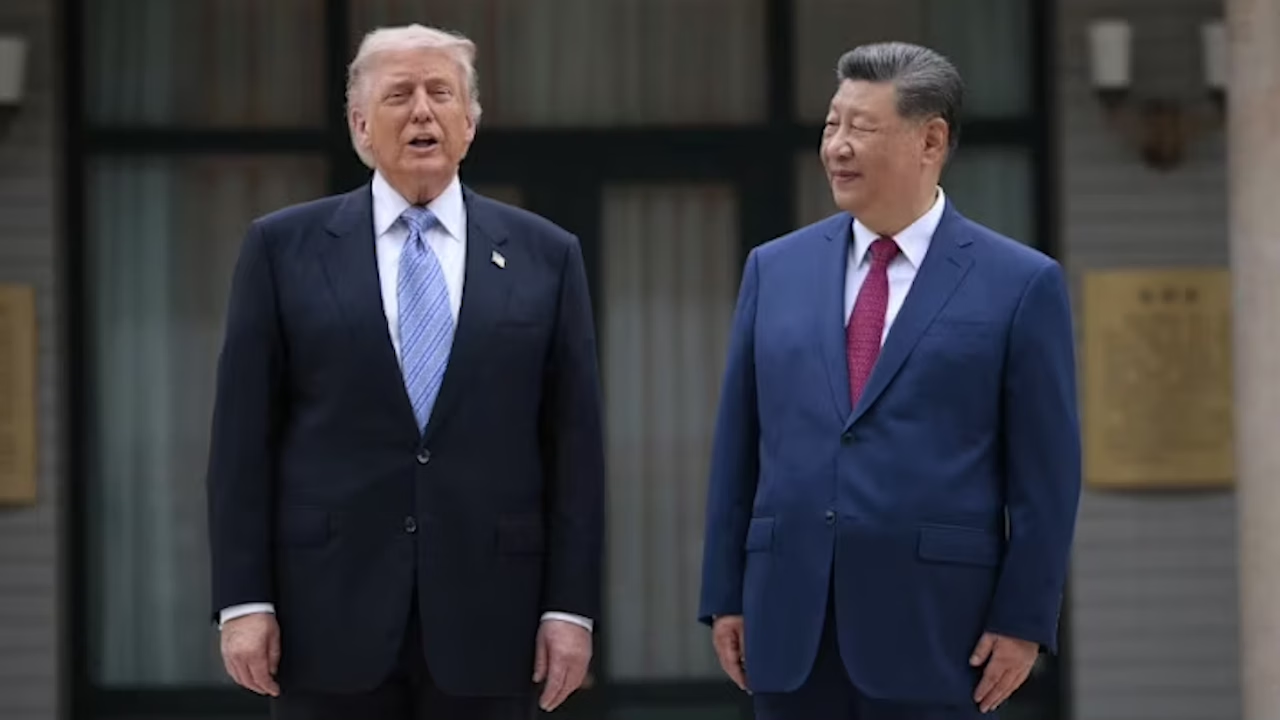
United States President Donald Trump said he had made “fantastic trade deals” with the President of the People’s Republic of China Xi Jinping, as the pair met on Friday, 15 May 2026, at final talks of a superpower summit. Trump did not spell out the trade agreements that he said had been sealed with China. But in a Fox News interview, he said one big deal involved China agreeing to purchase 200 Boeing jets.
Trump also said Beijing had voiced interest in buying American oil and soybeans. But big differences remain on Iran, Taiwan, and more, even though Trump told Fox News that Xi had effectively given the assurance that China was not preparing to militarily aid Tehran. Xi would like to see the Hormuz Strait open. Xi said it was a “milestone visit”, and that the two sides had to date established a “new bilateral relationship, which is a relationship of constructive strategic stability”.
Xi promised to send Trump seeds for the White House Rose Garden. Trump has boarded Air Force One in Beijing, wrapping up a closely watched two-day state visit. At Beijing Capital International Airport, Trump received a ceremonial send-off on the tarmac. Children dressed in some of Air Force One’s light blue and white colours waved American and Chinese flags as they chanted “farewell, warm farewell”.
Chinese Foreign Minister Wang Yi was at the airport to see Trump off.
After two days of carefully choreographed diplomacy and lavish symbolism, the summit between Xi and Trump in Beijing has offered a vivid display of two leaders with strikingly different styles trying to steady and shape one of the world’s most consequential relationships. Xi projected himself as a composed statesman and guardian of long-term stability, repeatedly framing Sino-US ties through the lens of global order and strategic balance. Meanwhile, Trump leaned into personal chemistry and spectacle, embracing the ceremony of the visit and praising his Chinese counterpart as a “great leader”.
While Trump was ad-libbing a bit, Xi seemed to be sticking to a script. Trump’s large CEO delegation added another layer to that message, signalling that business and deal-making were central to Washington’s framing of the visit. From the red-carpet airport reception and a symbolic visit to the Temple of Heaven, to a meeting inside the private Zhongnanhai leadership compound, China spared little effort in cultivating a sense of warmth and attention throughout Trump’s visit.
Even the state banquet music appeared tailored to Trump’s tastes. The summit was as much about signalling as substance. It unfolded against a backdrop of deepening geopolitical rivalry, tensions over Taiwan, ongoing trade frictions and conflict in the Middle East. Both sides emerged emphasising cooperation and stability, although their official readouts also revealed differing priorities beneath the cordial atmosphere.
Beijing highlighted what Xi called a “constructive strategic stability” in the bilateral relationship, with the Chinese leader saying both sides had agreed on this formulation.
The White House, meanwhile, focused more heavily on trade, market access, and investment. Yet the full scope of any concrete outcomes or agreements from the summit remains unclear. Whether the warmth on display translates into durable guardrails for the US-China relationship, or fades once the summit spotlight passes, may ultimately determine the longer-term significance of this chapter in Beijing.
A red carpet is seen at Beijing Capital International Airport as Air Force One waits on the tarmac ahead of Trump’s departure from Beijing. Rows of honour guards and youths line both sides of the aircraft. The send-off ceremony comes after Trump held talks with Xi and toured the Zhongnanhai compound earlier in the day. Trump shook hands with Xi as he left Zhongnanhai.
Trump and Xi could potentially meet four times in 2026, underlining just how important this bilateral relationship remains to both sides. Trump invited Xi to visit the White House on 24 September 2026. Xi’s last visit to the United States was in November 2023, during Joe Biden’s presidency, and before that, in 2017, during Trump’s first term. Both governments have stressed the importance of “stability” amid ongoing disagreements over trade, security, and broader geopolitical competition.
The relationship between Trump and Xi is essentially the only major “guardrail” left in what is considered the world’s most significant bilateral relationship.
Both leaders will likely want to keep talking, even if breakthroughs are not achieved, and the fact that there is still direct communication between Washington and Beijing is viewed as important by both sides. It was also notable that Trump mentioned September 24th when extending the invitation that falls during the week of the United Nations General Assembly in New York and could suggest Xi may combine a Washington visit with a rare appearance at the annual gathering. Other possible meetings could include the Asia-Pacific Economic Cooperation (APEC) meeting in Shenzhen in November, followed by the G20 meeting in Miami a month later.
Trump and Xi toured Zhongnanhai for more than an hour. The two leaders were seen walking side by side, stopping at points to admire the grounds and exchange remarks. The tour came ahead of talks over tea and lunch as Trump wrapped up his visit to Beijing. The two leaders had minced codfish in seafood soup, crispy and stir-fried lobster balls, and pan-seared beef fillet stuffed with morel mushrooms.
Also on the menu were kung pao chicken and scallops, braised seasonal greens, bamboo shoots, mushrooms and beans, and stewed beef in a bun, and steamed pork and shrimp dumplings. Dessert was chocolate brownies and fruits and ice cream. Coffee and tea was also served. Even as Trump touts “fantastic trade deals” with China, businesses are more immediately concerned about geopolitical risks, particularly the conflict involving Iran.
Companies are watching for signs of progress on trade, including the possible easing of export controls on American beef.
But the more pressing issue for markets is the situation in the Middle East. If businesses were able to see China take a larger role in helping to address the Iran conflict, namely, getting the Strait of Hormuz open in the near term, that would be something that would assure markets quite readily and quickly, and businesses would see impacts in terms of strategic planning and markets. But again, from the China side, things do not tend to move all that quickly.
Businesses are keeping an eye on the stability of US-China ties and what that could mean in practical terms, including tech exports and tariffs. Regardless of what the outcomes are, Trump will definitely present the summit as a triumph. Speaking of business leaders, a selfie moment featuring Tesla and SpaceX CEO Elon Musk and Xiaomi chief executive Lei Jun at the state banquet has gone viral on Chinese social media.
The hashtag “Lei Jun and Musk photo together” drew more than 20 million views on Weibo. Musk, who also owns the social media platform X, and Lei were seen posing together in a moment that quickly circulated online. Some social media users focused in particular on Musk’s wink during the photo, with others saying Lei nailed his celebrity encounter. Technology and business emerged as key themes from Trump’s visit to Beijing.
A prominent group of American tech executives accompanied the trip, including Nvidia CEO Jensen Huang, Tesla CEO Elon Musk, and Apple CEO Tim Cook, underscoring the continued importance of China as a market for major American firms despite ongoing geopolitical tensions.
The trip also produced several business signals, with Trump saying that China had agreed to buy 200 Boeing aircraft. Nvidia’s H200 AI chips were also closely watched amid American restrictions on advanced semiconductors, although allowing H200 imports would be a “sovereign decision” for China. The broader trajectory still points toward “selective decoupling”, even if pockets of commercial flexibility remain in some sectors.
In AI, the forces pushing competition still seem far stronger than the forces pushing collaboration. The United States treats advanced AI chips as strategically sensitive technology, while China is investing heavily to build its own semiconductor industry and reduce reliance on American technology over the long term. While Trump joined Xi for lunch inside Zhongnanhai, staff outside were served McDonald’s in a parking area.
The fast-food chain is one of Trump’s long-reported favourites. Trump has also leaned into that association publicly, including working a McDonald’s drive-thru window during his 2024 re-election campaign. Outside Zhongnanhai, bags of McDonald’s food were also delivered to members of the White House press pool, who were waiting in vans as they prepared for Trump’s departure for the airport and the long flight back to Washington.
Earlier, Trump and Xi spent around 10 minutes walking through the gardens at Zhongnanhai, in a brief, informal moment away from the negotiating table.
As they strolled past green columns and archways, Trump remarked on the flowers in bloom, saying those are the most beautiful roses anyone has ever seen. Xi told Trump he would send him rose seeds. The comment comes against the backdrop of Trump’s recent complaint that the White House’s garden did not have too many roses. Trump said he is “very impressed” with China as he wrapped up his two-day state visit.
Trump was speaking to the media during a visit to Zhongnanhai gardens with Xi in Beijing. He also said that both leaders spoke about the Iran war and agreed that Tehran should not have a nuclear weapon and that the Strait of Hormuz should be reopened. The events have been dominating headlines and front pages of Chinese newspapers and websites, with extensive coverage of Trump’s meeting with Xi.
A handshake between the two leaders featured prominently on the front page of Beijing News, a state-owned daily. Its main headline read, “A relationship based on constructive strategic stability”, a framing that appeared widely across newsstands in the capital. The People’s Daily, the Communist Party’s flagship newspaper, also ran front-page images of Xi meeting Trump, positioning the summit as its lead political story.
Shanghai-based news outlet The Paper shared highlights of Trump’s speech on its website.
In a video, Trump said that the American and Chinese people “share much in common, valuing hard work and courage, and (they) love their country and their home”. “How much does the American appetite love Chinese food?” read one video title posted by The Paper. In Hong Kong, the Ta Kung Pao newspaper described the meeting between both leaders as a “historic and landmark year for China-US relations”, splashing a photo of Xi and Trump at the Great Hall of the People across its front page.
The South China Morning Post led with the headline, “Xi and Trump seek stability in relations”, accompanied by an image of the two leaders shaking hands. Trump’s visit to the Temple of Heaven also received significant attention, with photographs appearing across multiple front pages and news sites. Beijing News published a lengthy commentary about foreign governments visiting the historic site during their trips to the capital and the cultural symbolism attached to it.
Trump discussed Iran with Xi and said that they do not want Iran to have nuclear weapons and want the straits open. The two leaders were at the walled-off Zhongnanhai complex in Beijing as Trump wraps up his state visit to China. Trump said that they have settled a lot of different problems that other people would not have been able to solve. He said he made “fantastic trade deals” with Xi as the two met for a second day of talks in Beijing.
A lot of good has come of it.
Trump said they have made some fantastic trade deals, great for both countries. He did not elaborate on what the deals were but had earlier told Fox News that a deal on Boeing jets has been struck. He said the Chinese side has also voiced interest in buying American oil and soybean. Asian markets are trading in a narrow range as investors await tangible results from US-China talks in Beijing, although an AI stock boom boosted Seoul to a new record.
Trump said that China agreed to buy oil and more soybeans from Washington. He also said China also agreed to order 200 Boeing jets, its first purchase of American-made commercial jets in nearly a decade. That was far short of the roughly 500 markets had expected, and Boeing shares fell more than 4 per cent after the comments. Still, markets understand the difference between stabilisation and resolution.
This summit feels less like a peace treaty and more like engineers reinforcing a suspension bridge during a storm. Trump is shown around Zhongnanhai, China’s tightly guarded central leadership compound, ahead of talks with Xi in a more private setting than previous engagements. The walled gardens of the compound feature winding paths, manicured lawns and carefully tended trees.
The two leaders are expected to have a closed-door lunch at Zhongnanhai.
Beijing appears to have spared little effort in rolling out the red carpet for Trump so far, from a high-profile airport welcome and a symbolic visit to the Temple of Heaven, to carefully choreographed touches at the state banquet last evening. At one point during the dinner, the Chinese military band played a song that has been associated with Trump’s public appearances back home, the disco hit Y.M.C.A. The song was played during a private portion of the dinner.
Trump closes his campaign rallies and most official events with the song, which he dances to while throwing slight fist pumps into the air. In 2017, The Stars and Stripes Forever was played when Trump and Xi inspected Chinese honour guards at the welcome ceremony. During Trump’s toast at the banquet, he pointed to historical exchanges between the two countries to highlight what he described as a long-standing “deep sense of mutual respect” between their people.
Trump noted that American founding father Benjamin Franklin had published the sayings of Chinese philosopher Confucius, while Chinese admirers of George Washington gifted a stone tablet in his honour to be placed at the Washington Monument. The tablet was inscribed with the words of a Chinese official praising Washington as a great general and statesman. He also cited the role of Chinese workers in building the railroad linking the American Atlantic and Pacific coasts, as well as American travellers to China who helped spread literacy and modern medicine.
Trump further highlighted that former American President Theodore Roosevelt, acting on a request from China’s ambassador, provided funding to establish Xi’s alma mater, Tsinghua University.
Tsinghua is considered to be one of the world’s most prestigious universities. Xi Jinping struck a warm and optimistic tone, framing ties between Beijing and Washington as vital to global stability. In his opening toast, he called for China and the United States to work together as partners rather than rivals. He believes that the China-US relationship is the most important bilateral relationship in the world.
Noting the 250th anniversary of American independence, Xi also referenced Trump’s “Make America Great Again” slogan. Xi said achieving the great rejuvenation of the Chinese nation and making America great again can go hand in hand. Both China and the United States stand to gain from cooperation and lose from confrontation. The two countries should be partners rather than rivals.